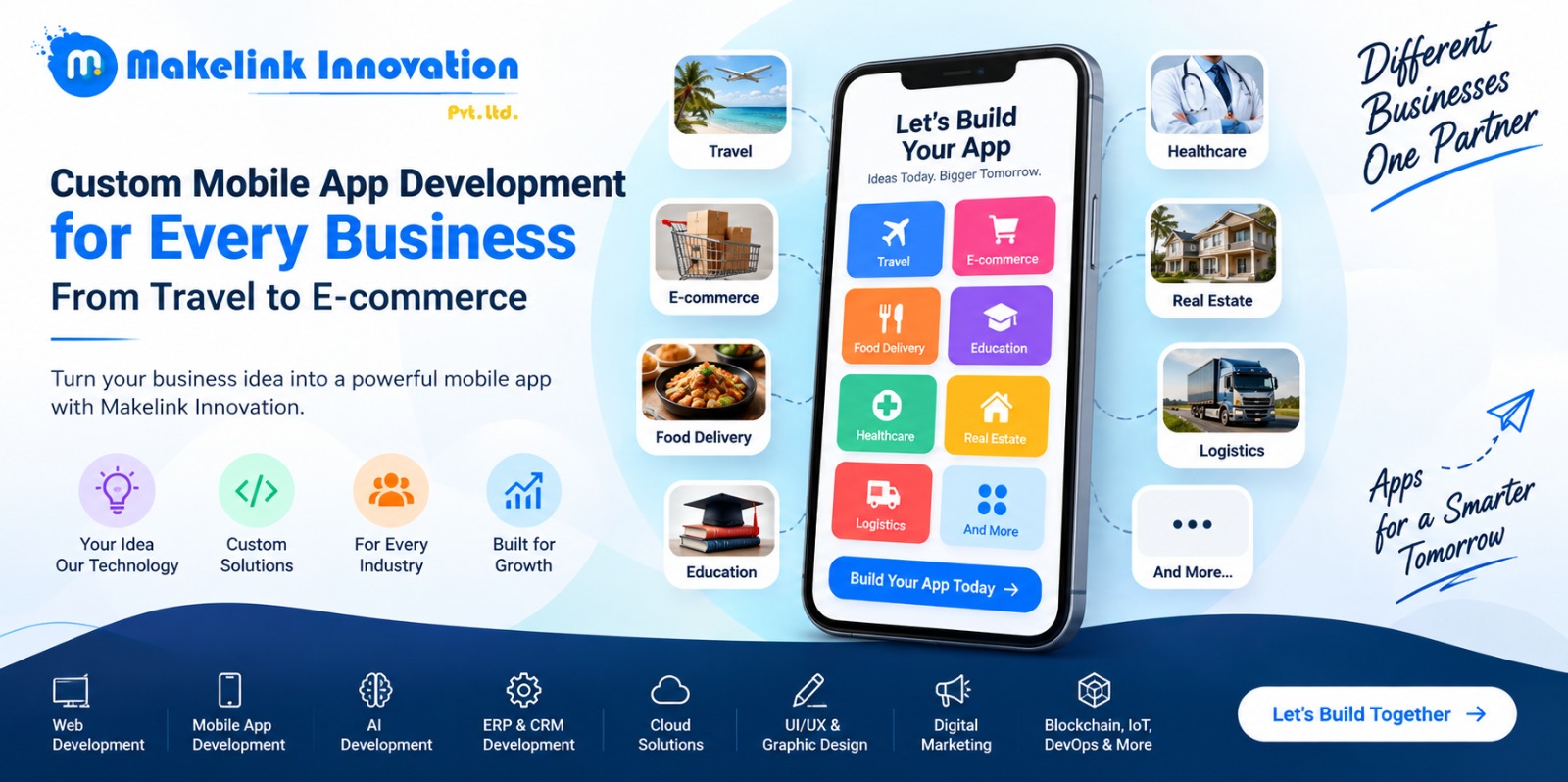
Mobile apps matter a lot for how companies talk to customers. A lot of people use apps every day. They plan a trip, get food delivered, and shop online. Apps also help them study new skills. Some apps are used to book visits or set up appointments. Others let users track a delivery as it moves along.
Still, each business wants different things. One travel company might need a booking flow and an itinerary view. An online store may focus on product lists, payments, and shipment updates. That is why many teams choose a custom mobile app instead of a generic product.
At Makelink Innovation, we turn your ideas into an app made for what you actually need.
An app can give your business a more direct link to customers. Rather than depending only on a website or a third-party site, you build your own space for users.
A well-designed app can help you:
Connect with customers more easily
Improve customer engagement
Make services more convenient
Increase repeat purchases
Send notifications and updates
Simplify bookings and orders
Build a stronger digital presence
The purpose of an app should always be clear. It should solve a customer problem or make an existing process easier.
Travel businesses can use mobile applications to make trip planning and booking more convenient.
A travel app can allow customers to explore destinations, view packages, check availability, make bookings, manage itineraries, and receive important travel updates.
For travel companies, having a dedicated application can also make communication with customers easier throughout their journey.
Makelink Innovation can develop travel applications based on the business model and services of the travel company.
Shopping online is common now. Many companies want a phone app too. It helps them connect with buyers in a new way.
A good e-commerce app can cover the basics. It may offer a product list. It can add search tools and filters. It can support a cart. It can handle safe payment steps. It can also show order status. Customer profiles, deals, and alerts are also common.
A tailored e-commerce app can be built with the business in mind. Developers can shape it around what the company sells. They can also match it to how customers buy.
Food places can use mobile apps to speed up ordering. It also makes the process easier for busy people.
With an app, shoppers can view menus. They can pick dishes they like. They can submit an order. They can pay in the app. They can also watch for updates while their food is being prepared.
Restaurant apps can go further. Some apps allow table bookings. Others support takeaway orders. Many include loyalty plans. Some include limited deals. They can also help restaurants message customers.
Learning is a clear area for mobile tools. Apps can support study and training in useful ways.
Schools, coaching centres, teachers, and online learning firms can use apps to share content. They can post courses and videos. They can add reading material. They can include quizzes and homework tasks. They can send alerts. Apps can also show how students are doing over time.
A custom education app allows the business to create a learning experience according to its teaching model.
Many healthcare companies use mobile apps to help people book visits and manage services.
What the business needs will decide what the app includes. Some apps offer booking slots. Others add doctor pages and reminder notes.
Common features can also include appointment records, video or chat consults, and messages between patients and staff.
Because the data can be private, security and privacy controls matter a lot. This is especially true when health details are involved.
Real estate firms also use mobile apps to help buyers find homes faster.
In these apps, users can look through listings. They can open images, read key facts, use search tools, and narrow results with filters.
People can also bookmark homes they like. They may send questions right from the app.
A dedicated app gives the business a clear place to show listings and handle incoming enquiries.
Delivery companies must keep control of customers, jobs, drivers, and packages.
A logistics app often covers order handling, route or package tracking, driver info, progress updates, and alerts to users.
Custom development allows the application to match the company's actual workflow and requirements.
Mobile app development is not limited to a few industries. Businesses across many sectors can benefit from a mobile application.
Fitness centres and gyms
Salons and beauty businesses
Taxi and transportation services
Event management
Retail businesses
Local service providers
Finance-related businesses
Customer support platforms
Appointment-based businesses
The features can be planned according to the business idea and customer journey.
At Makelink Innovation, we focus on understanding the business before starting development.
Our process can include:
Planning: Understanding the business idea, audience, and objectives.
UI/UX Design: Creating a simple and user-friendly application experience.
Development: Building the application according to the planned features and requirements.
Testing: Checking functionality, performance, and usability before launch.
Improvements: Supporting future updates and improvements as the business grows.
This approach helps create an application that is useful for both the business and its customers.
An application is often only one part of a company's digital ecosystem.
Makelink Innovation also provides web development, AI development, ERP development, CRM development, cloud solutions, UI/UX and graphic design, Blockchain, IoT, DevOps, and digital marketing services.
This means businesses can combine their mobile application with a website, customer management system, business software, cloud infrastructure, and online marketing strategy.
You do not need to work at a software company to make an app.
If you manage a travel agency, an online store, a cafe, a restaurant, a school, a clinic, a real estate business, a delivery service, a gym, or another kind of business, you can still create an app that matches your day to day work.
First, spend time on two things.
Know what your buyers ask for.
Then decide what issue you want the app to handle.
A good mobile app should not be just about looks. It needs to feel easy to use. It should fix a real need for customers. It should also help your business grow.
Apps can help across many areas, from trips and shopping to food orders, classes, healthcare, property listings, delivery, and other services.
At Makelink Innovation, we turn business ideas into mobile apps that work well. We offer custom development, UI and UX design, and other digital support.
Have a business idea for an app? Start with the problem you want to solve, and build the app around your customers.